Do we deserve to kill
Just MercyDo we deserve to kill? is the question Bryan Stevenson poses to redirect debate about capital punishment: away from whether an accused person deserves death and toward the moral authority of the society that would impose it. Spoken at a church service honoring Walter McMillian, it turns the injustice of one man’s prosecution into a broader test of how law responds to vulnerability, racial prejudice, and grief.
From desert to responsibility
At the service, Stevenson recalled what McMillian had taught him. The criminal justice system, he said, treats people better when they are rich and guilty than when they are poor and innocent; fear and anger can make a community irrational and dangerous. The question follows that account as its decisive reversal. Instead of treating execution as the natural consequence of a person’s crime, it asks what the act of killing reveals about the state and the people who authorize it.
The question does not erase the harm caused by violence or claim that accountability is unnecessary. Its force lies in refusing to make a death sentence seem self-justifying. In Stevenson’s telling, capital punishment cannot be judged only by the conduct of the condemned; it must also be judged by the fairness and humanity of the institutions imposing it.
The case behind the question
McMillian’s case gave the question its immediate moral weight. Although Black residents told Sheriff Tate that he had arrested the wrong man, Tate accepted Ralph Myers’s accusations without investigating McMillian’s life or whereabouts. On the day Ronda Morrison was murdered, McMillian was at home: relatives and church parishioners sold food from the yard, while he and a mechanic worked on the transmission of his truck. Yet the prosecution proceeded amid strong doubts in the Black community, and McMillian was condemned to death.
The book places that prosecution within a larger history in which racial power shaped both intimate life and legal judgment. After Reconstruction, racial restrictions helped reestablish white supremacy; laws against interracial relationships were part of that order. Later, even in counties with large Black populations, prosecutors could use discretionary jury strikes to keep Black people off juries. The Supreme Court’s 1986 decision in Batson v. Kentucky offered a way to challenge discriminatory strikes, but also gave prosecutors an incentive to find more creative means of exclusion. Against this history, the question asks whether a system marked by racial inequality can claim the authority to decide who deserves to die.
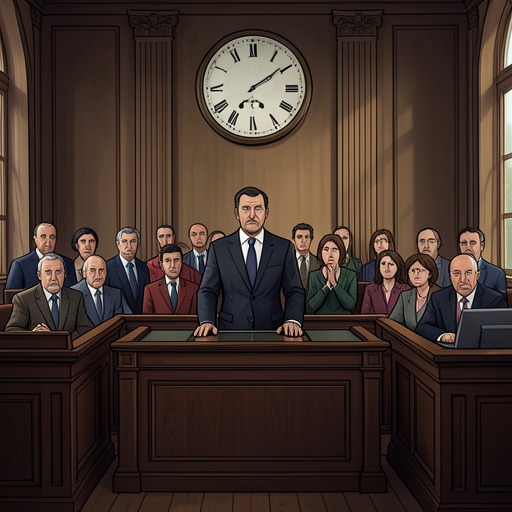
Its challenge also concerns whose account counts as evidence. When Tom Chapman defended McMillian’s conviction, he dismissed the opinions of community members as uninformed and insisted that evidence implicated McMillian. At trial, the courtroom’s changed arrangement sharpened the contrast: a metal detector and a German shepherd stood inside the door, and older white supporters of the Morrisons and the prosecution occupied benches where McMillian’s supporters had sat the day before. The question resists allowing official certainty to end moral scrutiny when the circumstances of a prosecution remain contested.
Victims, grief, and mercy
The question is set alongside the needs and experiences of people harmed by violence. After Herbert Richardson’s hearing, Rena Mae’s mother approached Stevenson on behalf of her injured family, explaining that promises of assistance had gone unfulfilled. Her request did not make Richardson’s case disappear; it made visible the human consequences that a courtroom proceeding alone had not addressed.
Ian Manuel’s relationship with Debbie Baigre offers another contrast. In 1992, while serving a sentence for shooting her, Manuel used his monthly phone call to apologize. Baigre, who had recovered physically and pursued bodybuilding and a women’s health magazine, began corresponding with him and later urged the court to reconsider his sentence and the inhumane conditions of his confinement. She acknowledged the destructiveness of his crime while arguing that what was being done to him was cruel and irresponsible. Her response separates recognition of harm from the conviction that further suffering is necessarily a just remedy.
Stevenson also recounts a grandmother whose grandson was murdered by boys who received prison sentences for life. She had expected their conviction and punishment to relieve her grief, but instead felt worse. What remained vivid was the memory of a stranger who sat beside her in court for nearly two hours, offering company without demanding speech. The account does not equate different crimes or losses; it shows that punishment alone may fail to meet the needs of those left grieving.
The question’s answer in the narrative
At McMillian’s service, Stevenson connected the question to mercy. McMillian, he said, had forgiven those who accused and convicted him and those who judged him unworthy of mercy. That forgiveness did not make the wrongful conviction harmless: Stevenson acknowledged that McMillian survived with injury and trauma. Rather, it showed how mercy could help restore a life marked by condemnation and give it a future beyond the wrong done to him.
The question therefore remains open as an ethical demand, not a slogan with an easy answer. It asks the reader to examine not only individual guilt but also the state’s fallibility, the history of racial power, the limits of punishment, and the responsibilities owed to victims and the condemned. In the book’s closing reflection on McMillian, the measure of justice becomes inseparable from the capacity to recognize human dignity and to respond to suffering with more than another sentence of suffering.